In an email with some friends the other day I wrote the term “the politics of the family.” My friend picked up on the term right away and said, “I don’t think I know what a ‘politics of the family’ (outside the concepts of Falwell and Rubio) means. Is this a thing?”
I spend so much of my time writing and thinking on my own that I forget that others don’t really know what I’m talking about when I use terms that seem commonsensical to me. “Politics of the family” is a phrase I must’ve typed 500 times in the last two years, as I complete my dissertation on a progressive politics of family life.*
I have a few examples of “good” politics of the family, by which I mean a political rhetoric based on familial ties that is not a capitulation to conservative family values politics. Most of my examples use familial relationships to demonstrate the injustice of America’s prison system, and I have posted about them in the last few months. But then I found Strong Families.
Strong Families stated vision:
Our vision is that every family have the rights, recognition and resources it needs to thrive. We are engaging hundreds of organizations and thousands of individuals in our work to get there.
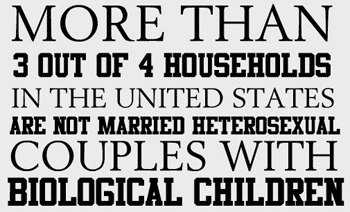
Strong Families is dedicated to highlighting issues affecting incarcerated persons, people of color, women, and LGBT and nonconforming people. Crucially, it discursively inverts the language of the traditional family and family values. Strong Families explicitly reaches out to people who do not live “behind the picket fence.”
*uh oh…another phrase that I haven’t defined adequately. Just bear with me for this one. I will get back to “progressive politics” at another point!


Leave a Reply