The first unit in my intro to political theory course has been on social contract theory. We’ve spent the past five weeks studying Hobbes, Locke, and Rousseau using OER materials I developed for the class (which I will write about separately in the future).
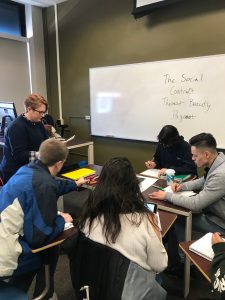
The first exam in the class will be held at the end of the week, and as such we spent today reviewing the ideas we’ve encountered so far this semester. Rather than conduct a traditional review session, we spent the time holding a beauty pageant for social contract theory.
I arrived at this assignment out of a desire to get the students to be able to clearly and cogently articulate the views of each thinker as well as to be able to enact a hypothetical debate among them. This is definitely not new territory pedagogically, but I think it is a useful skill for students, many of whom are encountering theory for the first time. It is also how I learned (and fell in love with) political theory, so I am partial to this method over other strategies that provide a more survey-style approach to major themes in theory.
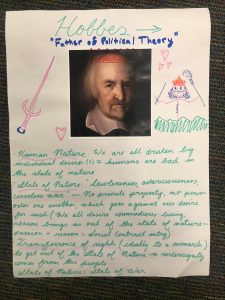
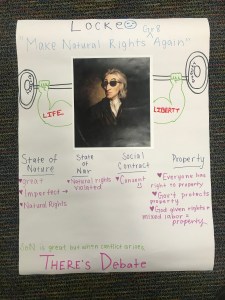
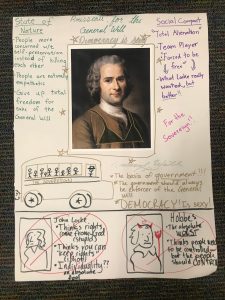
Knowing I wanted students to be thinking about each theorist as well as their interlocution, I thought posters would be a good activity. After printing out photos of these three dowdy white men, I thought students might enjoy making them more appealing. I am also conscious of the fact that this unit (and the canon of Western philosophy) is overwhelmingly white and male. Converting the figureheads of modern political thought into beauty pageant contestants seemed perversely captivating. Though I didn’t frame the activity as such, I was inspired by the queer potential of making Hobbes, Locke, and Rousseau speak to more modern formulations of popularity and appeal. There was something very camp about the process.
Students wrote both about the general tenets of the philosophers’ ideas as well as the rebuttals and critiques among them. Each group sent a representative to present their thinker. Appropriately, Hobbes was represented by a single student, Locke was discussed by two students, and the entire Rousseau group presented his ideas (this was not planned, but it was a brilliant demonstration of student comprehension). At the end, we decided to use a Rousseauian method for deciding the winner: students voted with their heads down so as not to see how others voters, and they could not vote for their own thinker (demonstrating the triumph of the general will over the particular will). In the end, it was a tie between Locke and Rousseau, which also felt appropriate.
Here are the beautiful contestants:


Leave a Reply