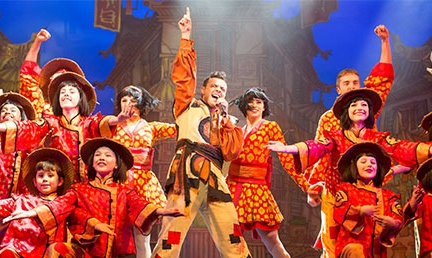
It being Christmas and all, my husband and I recently participated in the British holiday tradition of going to a pantomime. This year’s offering was Aladdin, featuring a handful of C-rate celebrities and some really explicit racism from the outset. The curtain opened on a caricatured chaotic Chinese street scene. Signs abounded advertising “Flute and Veg” and (sigh)”Flesh Flute.” Children came out in black wigs and pointy straw hats. The black genie spoke entirely in rhyme and thanked Aladdin for “setting him free” at the end. It was the sort of overt racism that one attributes to previous eras, a pastiche whose stereotypes are inconsistent with liberal narratives of progress and inclusion. And it was all part of a kids’ Christmas pageant.
In the aftermath of the Brexit vote the UK witnessed a rise in hate crimes, spawning the Twitter hashtag #PostRefRacism. #PostRefRacism was an attempt to document and draw attention to incidents wherein individuals used the referendum outcome to justify racist intimidation. From my very unscientific reading of the public mood, this interest in postrefracism has receded somewhat, though incidents of racist violence persist. For me, Aladdin served as an important reminder that the focus on #PostRefRacism must always also take into account the historical production of whiteness, or what we might call #PreRefRacism.
My foray into pantomime recalled how this country got itself into the mess of Brexit in the first place. The type of racial othering on display in a show aimed at children primes those children to understand different cultures as unidimensional, funny, foreign, and quintessentially Oriental. Obviously this type of cultural programming goes much deeper than Aladdin. One could write volumes on the cultural imperialism of Disney princesses, and despite its use of irony I’m still not 100% comfortable reading Huck Finn. As the “Chinese dance” in The Nutcracker reminds us, there is also something about Christmas that makes audiences particularly receptive to anti-Chinese racism.
As I sat in the audience that night I thought about this country’s long history of racist violence and its recent decision to leave the EU (a decision predicated on excluding the undesirable “others” of Eastern Europe and Turkey). I was reminded of The Black and White Minstrel Show, a BBC show featuring white dancers performing in black face, that was canceled in 1978 (!!), but that continued as a stage production into the 1990s. I was reminded of the names of landmarks that dot my husband’s hometown of Bristol, a city built on slavery: the Black Boy Inn; White Ladies Road; and Colston Hall, named for Edward Colston, a 17th century slave trader.
And of course, I was reminded of similar landmarks in my home country. America has its own history of racial violence and racist cultural depictions, rooted in the mother country’s Enlightenment and its attendant dichotomies of racial characteristics. This history does not excuse America by foisting all responsibility on British shoulders. Instead it reminds us that racism in both countries (and the Trump and Brexit phenomena that are its contemporary iterations) stem from the same pernicious ideology of whiteness that must be naturalized from a very young age. Consider Fox News’s Megyn Kelly’s assertion that “Santa Claus just IS white.” The intensity and conviction subtending Kelly’s claim derive from the innocence of her target audience: children. The need to defend the racial purity of a fictional figure demonstrates just how fragile whiteness really is.
Racial thinking shapes the way that people see the world, and the Aladdin panto experience reminded me that creating race entails actual work. This observation opens possibilities for a positive interpretation of agency. After all, if racial thinking is produced through practices, then changing those practices can result in changed thinking. Of course, changing practices is not as simple as altering the actions one does. Pantomimes in their modern form became popular during the Victorian era, a time that has given us so many of the institutions that shape our understandings of how the world works. Reporting from the front lines I can confirm that 19th century racist thinking is alive and well in the genre. Indeed, racism in cultural production is always lurking “right behind us.”


Leave a Reply